Wednesday, 27 July 2016

Lost in translation

In reference to my business I often talk about the value of meaningful communication, as that is one of the reasons I am passionate about perfecting written communication through editing. The way we communicate matters if you want to deliver your message well. Bad word usage, sentence structure, or even a typo can have a negative impact on your message. This article provides a fun yet concerning list of written errors that led to significant repercussions.
Whether you’re a large company hoping to achieve something significant, or a small business looking to attract the attention of a potential passing customer, you need to avoid mistakes. Typos and poor grammar can turn people off.

But one important thing to consider, which became more apparent to me in the last month, is that often mistakes are a result of problems in translation. This occurs not only in writing, but in speaking as well. I spent some time in France and Belgium recently, and had lots of fun observing the way things translate differently from French to English, and vice versa. I was already aware of this, as I studied French in high school, but seeing it and hearing it around me was an eye-opening experience.

For example, on a tour to the magnificent Mont Saint Michel in Normandy, our tour guide would sometimes say the name in what would technically be the English translation: Mount Saint Michael. And every time he said it, I smiled. It sounded kind of funny, and I think that’s because some things just don’t need to be translated – especially names.

I think part of communicating effectively involves acknowledging and understanding, to some extent, the different languages of the world. And it’s important to use some logic as well, because quite often direct translations don’t make sense.
For example, a chocolate croissant in French is pain au chocolat, for which the direct translation would be chocolate bread. But you probably wouldn’t put “chocolate bread” on a menu. You need to consider what chocolate bread might be referring to, and adjust it in a way that English speakers will understand.
Another good example is chocolat chaud, which is a hot chocolate. But if you tried to translate that as two separate words in that order without considering the way French works, it would come out as "chocolate hot".
It does seem that French words are a little back-to-front at times, like in “la tour Eiffel”, where the tower part comes first. But they usually translate well. You just have to be aware of the differences if you’re dealing with other languages. And don't assume that "tour" in French just means "tour" in English. Always find out first.

If, in your writing, you wish to use a language other than the one(s) you’re familiar with, just be sure you’re learning as much as you can about it. A mix-up in translation can be just as damaging as a typo. In general it matters to be thorough and strive to communicate in the way that your audience will understand.

On a side note, consider one of my favourite quotes by JRR Tolkien:
“Do not write down to children or to anybody.”
I agree that we should be as complex as we can be because surely that will encourage others to learn something new. Use other languages if you can. Use big words. Be clever and diverse. But my message is to be sure you’re doing it right. Translate properly, get your stuff edited, and just double-check things.

And a little bit of travel advice:
If you’re in a foreign country and struggle to understand the language, always consider context. If your taxi driver has stopped and is talking in his/her language and gesturing to the left and the right, and you’re too focused on trying to understand what they're saying, you might miss the very obvious fact that they’re asking whether to go left or right. It’s not always about words; sometimes body language and surroundings can give away what the person is trying to communicate. Just think about where you are and what you’re doing, and the meaning behind what is written or being spoken may become clearer.

If you see a red windmill in front of the words "Moulin Rouge" it might be fair to assume moulin rouge means "red windmill". Again, though, it's backwards, so if you took it word by word without considering French properly you would get "mill red". This is also another example of a time you would just leave the French name as it is, because Moulin Rouge sounds much nicer than Mill Red, or even Red Mill.


If you're looking for editing or proofreading services, be sure to visit my website to check out the services and rates I offer. Thank you for reading!


www.thewritething.com.au

Monday, 20 June 2016

How to answer a question properly (and why that’s important)


Answering questions properly and presenting solid arguments can be a challenge, so I’ve been analysing what works best and why it matters. This could be relevant to you no matter who you are or what you do, but perhaps more so if you are: a student, a public speaker, a politician, a job seeker, or a writer. Or maybe you believe in the value of a well-structured argument/debate.

Recently I got my hands on a copy of the latest Marie Claire (July 2016 edition), which is kind of weird for me. I don’t look at magazines unless I see something of value to read. Well my eyes caught something on the front cover that I wanted to check out: a Turnbull/Shorten interview (page 50, if you’re interested).
I’d rather not use politics as an example for writing advice, but this one was too good to pass up.

Reading through it I noticed the best answers – the ones I paid attention to and believed – were the ones that got straight to the point, provided lists or statistics, and didn’t use vague statements to avoid a clear answer. The influence those answers had on my interpretation – whether positive or negative – was fascinating.
Let’s look at an example.

Both men were asked, “What are the most important issues for women in 2016?”
(I will list and analyse the responses without specifying who said what, because if I do it will become a political blog post, which is not really what I’m going for…)

1) “Respect is absolutely critical, whether you’re talking about access to great jobs and business opportunities or domestic violence. The most important thing we can do is teach our sons to respect women. Respect for women is part of my DNA, which informs every aspect of our policies. Women hold up half of the sky, as the Chinese say, and they should be given due credit for it in every respect.”

2)
“If this country does nothing else in the next 10 years, we must achieve the equal treatment of women. Everything from more women in positions of power or in parliament, to bridging the pay gap, gender savings gap and the burden of unpaid care that falls on women, right through to the worst example of the unfair treatment of women in society: domestic violence. If we can do nothing else but solve those problems, we will be a very rich country. We need to put more women into more positions of power.”

Notice some differences?

The first response was centred on the overall importance of respect for women, which he repeated a couple of times. He also referenced a Chinese saying to support his opinion, which gives the impression he’s filling in space instead of elaborating on his points. It was nice, and he mentioned a couple of issues, but he didn’t focus on them enough. It wasn’t convincing or satisfying.
The second response, however, was very clear in its answers. He acknowledged equal treatment of women as the most important goal for Australians to achieve, and then he listed the exact issues that need to be addressed to achieve that. He told us what and how without tiptoeing around it. The first response did offer up a little bit of what and a little bit of how, but the second response was far more effective at doing that.
The question is: Why?


This sort of pattern seems to emerge a lot in politics, but also in other familiar places, like in essays and job interviews.
I remember during my studies sometimes I didn’t understand an essay question or I couldn’t figure out how to answer one, so I would just try to write as much as I could about the topic. I thought that would be enough and it sounded great because I could write really well, but my content lacked any real meaning because I was avoiding the point of the essay. As a result, I failed to answer the question and subsequently received lower marks.

I wish I had done then what I’m about to suggest to you all now.

To answer a question properly you need to first reread the question and realise what it is asking of you. A question about the causes of climate change, for example, is not the time to get carried away about your opinion, or even what the results of climate change are – unless, of course, you are asked to do so. If the question asks about causes, you must list causes. What are the causes? Why are they causes? How impactful is each cause?
If someone asked me a question like that, I’d probably go off on a tangent and talk about the results, and what it means for the future of Earth, and so on. I might provide good information and I might have more fun, but in many cases my arguments could fall flat, because we need to focus on what we’re specifically asked in order to satisfy our audience.


Now, of course, this applies more strictly to school and university. Essays usually require you to answer the questions very specifically. It really depends on what you’re being asked to do. But if you lose track, you risk not answering the question at all. In the essay context, you’ll get lower marks. In the interview context, your answers won’t be valued or taken seriously. It matters.

So, if you don’t understand the question, spend some time making sure you do. If you’re unclear on the meaning of a word, look it up. If the wording confuses you, get someone else to read it to you or provide their take on it. You can also ask whoever is asking the question to clarify what they mean.
And, if it helps, re-write the question for your own sake, in a way that makes the most sense to you.

Once you’re clear on what the question requires of you, you need to think of the best way to present your answer. Structure matters. Let’s look at how our politicians utilised structure.

2) He identified the problem: gender inequality.
He listed the exact issues, as requested by the question: more women in parliament/power, bridging the pay gap and gender savings gap, the burden of unpaid care, and domestic violence.
He recognised the impact of these issues, that our country will be rich even if gender inequality is the only thing we solve.
He concluded with a suggestion on how to begin the process, by putting women in positions of power.

Evidently the structure of this response is clean and carefully considered. It has a beginning, middle, and end. I’m actually a little impressed he managed that in an interview context. Now look at the first response, and notice how the structure isn’t as easy to follow, which makes it harder to absorb.

1) He didn’t identify the problem, but rather jumped straight to an answer, which was to respect women.
He mentioned a few issues, which addressed the question briefly: career and business opportunities, and domestic violence.
He reiterated his view on respect.
He made it personal by referencing his own DNA.
He used a Chinese saying to support his beliefs.

After reading through both responses many times, I have determined that one good way to introduce your response is by looking at why the question is being asked in the first place. If it’s about the causes of climate change, I would probably open with an acknowledgement of climate change as a real and important issue, and then lead into how it has become such an issue by listing the causes.

In the case of our politicians, the second response approached it well because he had things he wanted to acknowledge, but he prefaced them with an important statement before simply listing them. He took the time to first address the fact that the question was being asked, by pointing out how important it is to eradicate gender inequality in the first place. Then he was able to list the various examples of gender inequality to solidify his stance.
The problem with the first response was that he seemingly heard “women’s issues” and jumped straight to “respect women” instead of framing something a little more substantial. That isn’t to say respect is a bad thing to bring up. It just doesn’t get your attention like the second answer does. And in essays and interviews and speeches and arguments, you want to get your audience’s attention with something more specific.

As you can see, structuring your response in the right way can give you a head-start. But the content matters just as much. Response 2 offered a good number of examples of gender equality issues, and they were all solid. Response 1 offered only a few, and they were not necessarily good choices. Domestic violence was a good one to bring up, of course, but the other two were not as well thought out. It’s almost one point spread across two. This could leave readers thinking perhaps our interviewee is a little ignorant or indifferent on the topic. Having the right information is the first step, and knowing which to focus on is what can put you ahead. It shows that you understand what you’re talking about.

However, to be fair, both responses offered their opinion on what to do about it. 1 said we need to respect women and teach our men to respect women. 2 said we need to give women more power. Both are good points, but there’s a subtle difference that helps the second one over the line.
Respect is a very broad and general term. It’s easy to throw that word around and know it means good things. But suggesting women belong in positions of power requires a little more preparation. You have to first know that there aren’t enough women in power, and then know that women being in power will be useful to inequality and the country as a whole, and then understand its importance in solving the overall problem. This alone makes the second response even stronger.

And all of this is important because you need your readers/audience to understand you and believe you. If you have an important message to get across, it won’t happen with poor content and structure. If you have to write an essay, you’ll give yourself the best chance at high marks if you put thought into your response. It matters even if you’re not answering a question. You need to be able to provide people with the information they need or want to hear. If you don’t, they may lose interest or miss the point, and it really sucks when you’re not heard or understood.

If you have something important to say, or you need to hit the nail on the head in an interview, it’s a good idea to consider some of this stuff. So, I’ll summarise:

Do:
- understand your question – clarify its meaning, and re-write if you need to
- consider the structure – acknowledge the topic/question/problem, list the reasons/examples, show its importance, and provide a possible solution
- be straight to the point
- use good content – lists, statistics, numbers, facts
- know what is relevant – the content that will answer the question and appeal to your audience the most

Don’t:
- use vague statements and ideas that could be applied to anything
- tiptoe around and avoid the actual question
- forget the question
- go off on tangents and get distracted
- go in blind without being sure you understand the question or topic

Why?
- to engage your audience/interviewer and hold their attention
- to help people understand and believe your message without confusion
- to have your views valued and taken seriously (in interviews, for example)
- to demonstrate your knowledge and competence to get higher marks (in essays, for example)
- to spread important information in the most effective way
- to satisfy your audience by actually answering the question


And here’s why it matters to everyone else if you’re not answering questions well:
If you struggle to make your point, it comes across as though you don’t know enough, you don’t care enough, and/or you’re lying. And those are not good things if you’re in a position to answer/argue/explain.
But, of course, sometimes it’s just social anxiety, which is totally understandable.

I hope this proves useful to some of you!


If you're looking for editing or proofreading services, be sure to visit my website to check out the services and rates I offer. Thank you for reading!

www.thewritething.com.au


Sunday, 5 June 2016

The question mark

When editing, I see people misuse question marks quite often.

You should only use a question mark at the end of a question.

The problem is, many think it belongs at the end of a sentence like this:
I wonder how many people attended the concert?

That is not a question, and so the question mark should not be there.
You’re stating that you’re wondering the amount, but you are not actually asking what the amount is.

If you were asking, and wanted to use a question mark, it should look like this:
How many people attended the concert?
OR Do you know how many people attended the concert?

Question words at the start of sentences can help sometimes. These include: what, when, where, who, whom, why, would, should, could, how, do, etc.
But that can also be misleading since we can ask questions without those words, and we can use those words in a non-question context.

For example, I can ask a question without using a question word:
Remember that time we learned about question words in primary school?
Or I can use a common question word without actually asking a question:
How we teach grammar is very important.

I know in informal conversation question marks are used a lot more freely (I do it myself sometimes, for emphasis or for comedy), but in formal writing you need to get it right.

Just remember, if you’re not actually asking a question, you shouldn’t use a question mark.

Sunday, 22 May 2016

Which or that?


This one can be a little tricky if you haven't learned the rules yet. Read on for a quick explanation.

“Which” should be used when
you’re adding information to the subject (a non-defining clause).
“That” should be used when
you’re defining the subject (a defining clause).

If you don’t know what to use, ask yourself: Does the second clause add information to the first clause, or does it actually define it?

If it’s adding information, put “which”. And make sure there is a comma before it too! Non-defining clauses will always require a comma. There will be a natural pause before the additional information.
If it’s defining, put “that”. No comma needed here.


Here’s how it might look:

“We drank beer, which I preferred.” – I use “which” because I am simply stating that I preferred beer over anything else. This is just additional information describing how I felt about generally drinking beer.

“We drank the beer that I prefer.” – I use “that” to indicate we specifically drank my favourite beer. This defines the beer we drank.

And here’s an example of incorrect usage, to help you tell the difference:

“I parked in the spot which was closest to the entrance.” – You’re defining the parking spot, and there is no natural pause after “spot”, so “that” should be used here instead.

Just look for whether you are adding information or defining, and whether there is a natural pause between the clauses.

That's all, folks.


If you're looking for editing or proofreading services, be sure to visit my website to check out the services and rates I offer. Thank you for reading!


www.thewritething.com.au

Sunday, 15 May 2016

Track Changes: what, why, and how


If you’re a writer or editor and you don’t know what Track Changes is, you might be very thankful for what you’ll read next.

If you do indeed write, it’s always important to get your work edited. If you’re strapped for cash, even getting a friend or family member to look over your writing is better than nothing.
But what happens if you send through your Word document, they make some changes, send it back, and you can’t quite pick out what they’ve changed? It would be extremely inconvenient and time-consuming to bring up the before and after documents and compare them word for word.
Wouldn’t it be great if there were some feature that tracked the changes that you or someone else made to a document on Microsoft Word?

Well, there is. It’s called Track Changes, and it’s a part of Microsoft Word. I’d like to write about it today because I believe it has great value for writers and editors everywhere.

What is it?
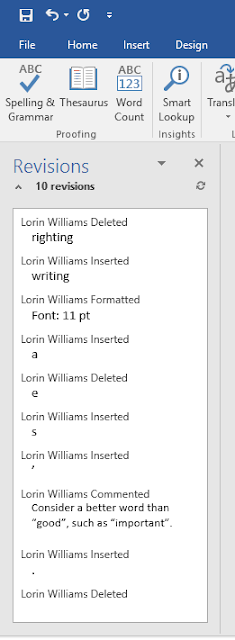
Track Changes is a review feature of Microsoft Word. Once enabled, it records any changes you make to the document, including formatting, font, insertions, deletions, and so on. You can also insert comments for the next person to read when they go through it.
You can do this sort of thing with pen and paper, which is how I was initially trained, but that's not always an option. I actually thought electronic editing would be kind of weird and no fun at all. But I was so wrong.
Since becoming familiar with Track Changes, I’ve grown very fond of it.

The idea is that a writer will send their work to an editor, the editor will do their thing using Track Changes, and then the writer will accept or reject the changes once the editor has sent it back. The comment feature is also a really convenient way to point out anything of confusion or doubt, to ask questions, or to explain edits.

I also like to throw in encouraging comments here and there when I particularly enjoy what I am reading. Sometimes if it makes me laugh, I let the author know. Genuine feedback on the overall content is as valuable as fixing technical errors, and Track Changes is a nifty way to do this.

Why should I use it?
It’s effective and convenient, saves paper and ink, and makes communication between author and editor a lot easier.

You could be anywhere in the world and still edit a document for a client, because all you need is a computer.
It’s also very easy to use. It doesn’t take long to get the hang of it, and when you do, it becomes a second nature. I think writers should become as familiar with it as editors are.
The comment feature is brilliant, because you can insert the comment right where the issue is and the author will know what part of the text you’re referring to. There is no ambiguity and they can adjust it immediately. The same applies to other changes made – they are clearly highlighted in a different colour and can be fixed at the time and incorporated into the document with great ease.
And if the author wishes to, they can insert their own comments with questions or ideas and send it back to the editor.

It’s efficient, simple, and versatile. I still love the red pen and the proof marks, but this is just a better way to do it if you can. All you need is Microsoft Word and email.


How do I use it?
Track Changes can be found under the “Review” tab when you open Microsoft Word.
You’ll find a section off to the right that says “Track Changes”. Simply clicking that button will turn Track Changes on, and any changes made to the document will be subsequently tracked.


Next to the button there are three other subheadings to personalise the feature. This part is basically your way to adjust how you see the changes as they are made.

"All Markup” will show all changes made. “No Markup” means that you won’t see the changes highlighted until you choose to reveal them again. That might be preferable if you don’t want too many visual distractions, which can also be achieved by selecting “Simple Markup”. “Original” shows you the document before any of your changes were made.


You can also pick and choose which revisions you wish to see. For example, you might find that seeing your format changes is a bit distracting, so you might want to untick formatting while you work. Or perhaps you want to go over only your formatting changes to be sure they are consistent, in which case you would untick everything but formatting.

You also get to choose whether the changes will appear in the text, which can be clearer, or off to the side in the margin, which can be neater.


Furthermore, there is a reviewing pane you can enable which allows you to navigate your changes.


How you adjust the above settings is entirely up to your preferences – whatever allows you to focus as you make changes or review changes.
But if you’re on the reviewing end, you might want to be sure everything is ticked and visible so you don’t miss anything as you go through it.

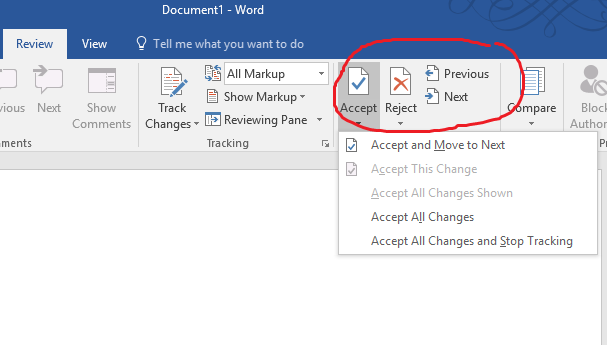
Speaking of which, there are still more buttons you can use. You can “accept” or “reject” each change as you go through them all using the “previous” and “next” buttons. You can choose to accept or reject all changes but I think it’s always good to look over them first. Hitting “previous” or “next” will just help you to navigate from change to change easier, but you can always navigate through the document manually if you prefer.


Nifty, right?

I hope this has been informative and encouraging for those of you who could really use a tool like this. Computer stuff scares people off sometimes, but I promise this one is worth trying. If you have any questions or doubts, feel free to ask away!


If you're looking for editing or proofreading services, be sure to visit my website to check out the services and rates I offer. Thank you for reading!www.thewritething.com.au


Wednesday, 4 May 2016

I could/couldn't care less

It’s a common phrase, but you’re probably saying it wrong. So many people say it wrong.
But it’s so easy to figure out the right way, if you just take a second to look at the words you’re using and pay attention to what they mean before you use them.

I could care less
This is the one people use incorrectly. It literally means you DO care, because you’re saying you could care less than you currently do. It’s pretty self-explanatory. The problem is, many people use this phrase when what they’re really trying to say is…

I couldn’t care less
This one is what you’re looking for! It literally means you could NOT care less, which is a pretty effective way of indicating you just don’t care. If you use the first one (the wrong one), clever and observant people will be like, “HA! So you DO care. Joke’s on you!” And I don’t think that’s what you want.

So next time you want to tell someone just how much you don’t care, remember this: the fact that you DON’T care means you need to chuck a NOT in there. It’s “could not”. That is unless you want to be a bit of a smartass and tell people you do care, in an obscure sort of way.

This is how you might do that:
“Do you even care that I got hit by a car yesterday?”
“Well, I suppose I could care less. That sounds pretty serious."

But the more common way should look like this:
“I have an assignment to do and it’s about—”
“I don’t want to hear it. I couldn’t care less.”

Just keep in mind that sounds kind of mean. There are nicer ways to show disinterest.

If you're looking for editing or proofreading services, be sure to visit my website to check out the services and rates I offer. Thank you for reading!

www.thewritething.com.au

Saturday, 30 April 2016

The importance of hyphens


You simply cannot misuse hyphens.
Why? Because the meaning of an entire story can change.
How? Consider this article:
http://www.earthables.com/train-hopped-1669269823.html

Obviously the article is telling a story about an eighteen-year-old who hopped trains for so many years. Cute story. But go back and read the title again.
I personally didn’t know trains could hop, let alone use a camera.
In case you missed it, the wording of this title implies that the train is eighteen years old and did the hopping. Can you see why that is?

The eighteen-year-old train hopped vs. the eighteen-year-old train-hopped.

Hyphens are primarily used when joining two words together to make a compound word. Without a hyphen, train-hopping is no longer a thing the teenager is doing. It is now a hopping train.
Compound adjectives are the easiest example here. You work a nine-hour day. You go for a half-hour walk. You write a 300-page story. You dress in an old-fashioned style.

One key way to know whether you need a hyphen or not is to ask yourself whether you could put “and” between the two words. If not, you probably need a hyphen because the two words are combining to mean something different from their separate parts. Another way to know you need a hyphen is if the words don’t make sense used separately. For example, a blue-eyed girl needs a hyphen because you cannot say the girl is blue and eyed. But if the girl has big blue eyes, that’s fine, because you can say she has big eyes and blue eyes.

If you go back to the article about the train-hopping, you’ll find in the first sentence, right at the beginning, there is another error within the hyphen category. The “18-years-old” does not require hyphens. You only say 18-year-old when you’re calling the person an 18-year-old, not describing them as 18 years old. It’s “I have blonde hair” vs. “I am a blonde-haired girl”.
One thing they did right with hyphens was using one in “eye-opening”. A hyphen used there is correct.

So hyphens are important where compound adjectives are concerned. But just to complicate things, there is a rule that states a compound adjective that follows its noun, instead of coming before it, doesn’t require a hyphen.
Chris Hemsworth is a well-known actor (the noun comes after, so a hyphen is required).
The actor Chris Hemsworth is well known (the noun comes before, so no hyphen is required).

There are phrases that need to be hyphenated too, like run-of-the-mill. That particular phrase works as an adjective. Without the hyphens it could be interpreted differently. The hyphens make it one thing instead of lots of different things – a combination of several words to create one new meaning – so they’re very important to use in these situations.

In the case of the train, that is not a compound adjective, but rather a kind of verb. This is a very specific example and it gets a bit tricky sometimes. The Chicago Manual of Style has a fantastic table (
http://www.chicagomanualofstyle.org/16/images/ch07_tab01.pdf) which outlines the various compound terms and how to deal with them. I definitely recommend reading through it if you are in doubt.

At the end of the day, if what you’re saying can be interpreted differently without a hyphen, you should probably consider the hyphen. Trains should only hop in strange fiction stories, not in news articles.


If you're looking for editing or proofreading services, be sure to visit my website to check out the services and rates I offer. Thank you for reading!www.thewritething.com.au